


As students filled the Eagle Gym for Sandburg’s Winter Fest assembly, anticipation quickly turned into excitement. Teams from each grade gathered on the floor, surrounded by classmates in the stands, ready to compete in a series of games that required focus, communication, and teamwork, all for a chance to win a $500 prize.

What began as lighthearted competition quickly intensified. With every round, the allotted margin of error narrowed. Laughter gave way to concentration as teams adjusted to the pressure of the moment.
During the elimination rounds, teams remained on the gym floor while scores were calculated and announced. After each round, teams with the lowest point totals were eliminated.
“I was so nervous because they hadn’t told us our total scores yet, and I knew that moment would decide if we continued or got eliminated,” freshman Cruz Arroyo explained. “I kept thinking about how hard our team worked and hoping it would pay off.”
Instead of watching from the bleachers, Arroyo was part of the movement on the gym floor, sharing the moment with peers across the gym. “Being able to see so many peers around me all together for one purpose showed me what being a Sandburg Eagle was really about.”
While the games held the crowd’s focus, the crew supporting the event worked quietly behind the scenes to keep everything running smoothly. Coordinating transitions between rounds, confirming results, and keeping teams informed required constant attention. Those responsibilities ensured the assembly stayed focused and fair as the competition progressed.
Student council sponsor Ms. Doe played a central role in that process, overseeing scorekeeping and organization throughout the week leading to the assembly. “Mrs. Fazekas and I were calculating team points, looking at how each team did in each game, and determining which teams would make it to the assembly.” Teams earned points all week long through Spirit Week activities, including daily spirit wear participation, competitive challenges such as stacking boxes within a certain time limit and other grade-level competitions. Only the top two teams from each grade level advanced.
Beyond organizing the flow of the assembly, the design of the games encouraged students to rely on one another in different ways as the competition progressed. No single round defined a team’s success; instead, each activity called for a different contribution, allowing everyone on the floor to play a role. Events included a trivia round in which students and teachers worked together to answer questions, as well as events such as dodgeball, and skill-based tasks that tested coordination and balance.
“We had a mix of some athletic competitions and some more knowledge-based competitions,” Ms. Doe said. “The goal was really just to win as much as you can [in order] to get to the last competition.”
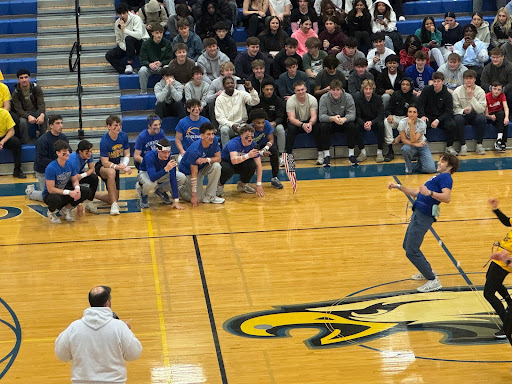
For junior Ribhi Sulieman, the later rounds required more than physical ability. As teams were eliminated, decisions became more deliberate, with each action carrying greater weight for the group as a whole. With no clear indication of the standings, teams had to stay engaged regardless of how they believed they were performing.
“The trivia game was probably the hardest. We had to really lock in as a team,” Sulieman said. “I was a little nervous,” he added. “The goal was to beat the sophomores.” The pressure, however, didn’t break the group’s focus, as the team continued to respond together through each round.
By the final rounds of the B assembly, the competition narrowed, with the junior class team ultimately emerging as the winners and securing the $500 prize.
As the assembly came to an end, what lingered was not just the outcome of the competition, but the way students had shown up for one another throughout it. From moments of uncertainty to rounds that demanded quick trust, the Winter Fest assembly created a space for students to step into shared responsibility and presence.